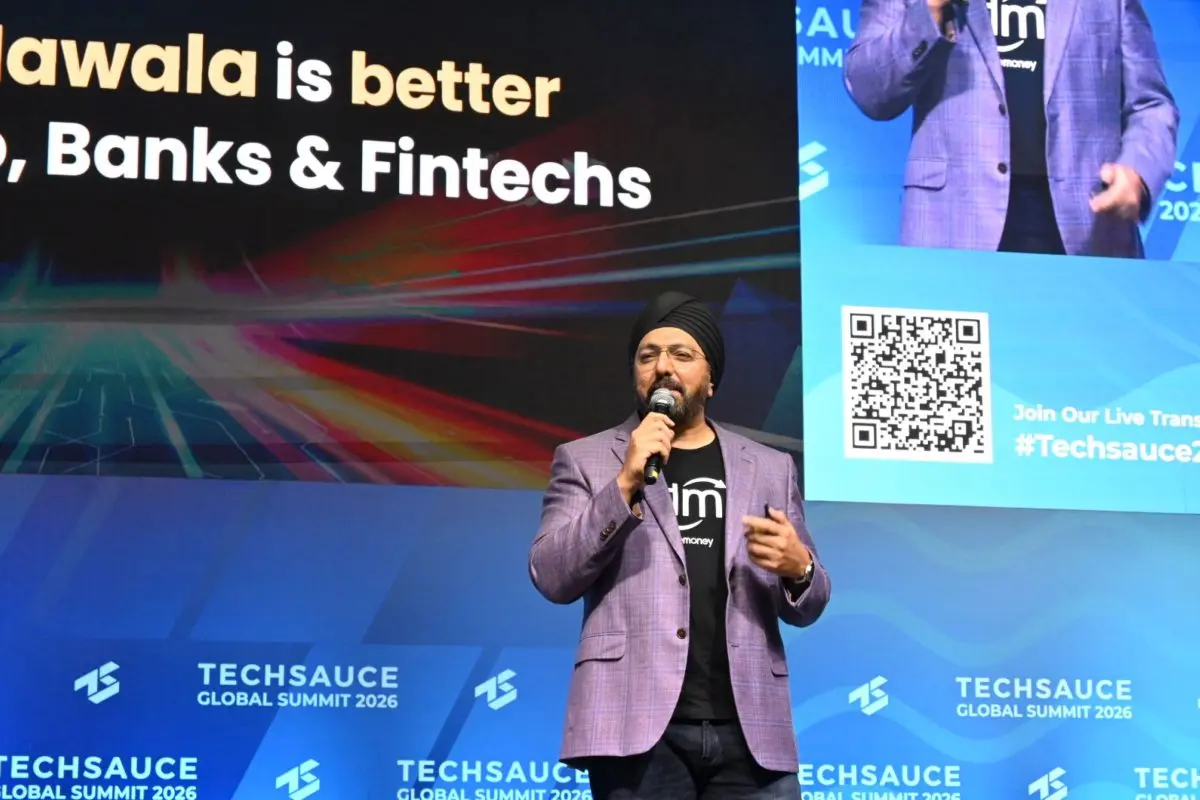
Addressing tech leaders and financial innovators at the Techsauce Global Summit 2026, Aswin Phlaphongphanich, CEO and Co-founder of DeeMoney, delivered a provocative reality check on the international payments industry. Drawing on DeeMoney’s scale—having processed over $5 billion in cross-border volume and millions of transactions—Aswin revealed that after a decade of scaling Thailand’s leading cross-border fintech, the hardest part of moving money across borders isn’t the technology.
“When we founded DeeMoney, we believed building a slick app and digital onboarding was the ultimate answer,” said Aswin Phlaphongphanich, CEO and Co-founder of DeeMoney. “The reality we uncovered after moving billions of dollars is that technology merely moves information. Trust is what actually moves money.”
In his keynote session, “Unspoken Facts of Global Payments: How Fintechs Changed the Banking Game,” Aswin pointed to informal networks which still move $300 billion annually purely on informal trust, capturing substantial remittance volume in underserved corridors where formal banking access remains limited.
Building DeeMoney to process over $5 billion across global corridors forced Aswin to confront a reality that many tech founders overlook: global payments are not actually global. While infrastructure like SWIFT handles international messaging, no single money highway exists; executing seamless transfers requires meticulously stitching together disparate local banking rails and regulatory frameworks country by country. This hands-on expansion revealed that payment platforms are fundamentally treasury and liquidity orchestrators. Delivering instant, 24/7 settlements—such as guaranteeing funds landing in a recipient’s overseas account at 3:00 AM on a Saturday—demands massive pre-funding and round-the-clock currency management, far beyond what sleek software alone can accomplish.
This operational iceberg also reframes how both the industry and consumers must evaluate payment costs. Low advertised fees belie the immense operational complexity taking place behind the scenes; delivering a simple, low-cost transfer requires orchestrating foreign-exchange spreads, stringent sanctions screening, pre-funded liquidity, and continuous background reconciliation. To illustrate why so many fintechs struggle to scale internationally, Aswin described network viability through a strict multiplicative formula: Technology x Compliance x Liquidity x Trust. Because these factors multiply rather than add up, a failure in any single element causes the entire system to break down. For customers, overcoming this complexity is what transforms a simple transfer tool into a reliable financial partner that delivers absolute certainty when it matters most.
Aswin highlighted a widening structural divide between how legacy financial systems were designed and how modern consumers actually live. Traditional banking infrastructure was engineered primarily for custody, control, and risk management. However, the rapid acceleration of e-commerce and real-time digital services over recent years has fundamentally altered expectations towards instant, 24/7, and seamless payments—a level of immediacy that traditional banking architectures were simply never designed to support.
“Customers do not pay us simply to transfer funds from point A to point B,” Aswin stated. “They pay us to remove uncertainty. The true role of a fintech is to bridge the gap between bank-grade stability and customer-grade speed, ensuring absolute certainty that money will arrive safely.”
Looking to the future, DeeMoney highlighted how the cross-border architecture will evolve to solve the industry’s heavy pre-funding and liquidity costs. Across the international financial landscape, deposit-based tokens and stablecoins (such as USDC) are emerging as potential instruments that could eventually help reduce treasury liquidity demands, subject to evolving regulatory frameworks and central bank approvals.
Furthermore, as payments become invisibly embedded into broader digital workflows, the industry will undergo a fundamental shift from human-initiated trust to machine trust; where autonomous AI agents authorise and execute financial transactions on behalf of users.
To learn more about DeeMoney’s vision for the future of cross-border payments, visit www.deemoney.com